Author: rhoda437

  • Sophy & White: The Dunollie Collections Unboxed – April 2025 Update

    Sophy & White: The Dunollie Collections Unboxed – April 2025 Update

    As we move towards the conclusion of the second phase of our project; Wear it or Sleep in it, our team is excited to share the incredible progress we’ve made. Over the past two months, we have been deeply engaged in planning and implementing key aspects of this project, from developing a unique shop product to curating a pop-up exhibition that will serve as the grand finale of this stage. Alongside this, our work with the collections team continues to expand our understanding of Dunollie’s textile heritage, ensuring that these remarkable objects and traditions are preserved and shared with the wider community.

    At its core, this project has been about fostering a shared passion for textiles, bringing together a group of makers, historians, and volunteers to explore Scotland’s rich weaving and spinning traditions. Through Wear it or Sleep in It, we have aimed to:

    ✔ Create a welcoming textile group where people can gather, learn new skills, and connect through a shared love of craft.

    ✔ Deepen our knowledge of Dunollie’s collection, including its blankets, plaids, shawls, and sashes.

    ✔ Explore the historical roots and production methods of Scottish textiles.

    ✔ Strengthen the expertise and capacity of our textile collections team.

    A New Shop Product: Inspired by Tradition

    One of the most exciting elements of this phase has been the development of a creative retail product inspired by Dunollie’s textile heritage. With the help of our Stitch & Spin group, we have sourced Shetland wool, and the team has been enthusiastically crafting a beautiful range of handmade coasters. Their productivity has exceeded expectations, these handcrafted pieces will officially launch at our upcoming pop-up exhibition, giving visitors the opportunity to take home a piece of Scotland’s textile story.
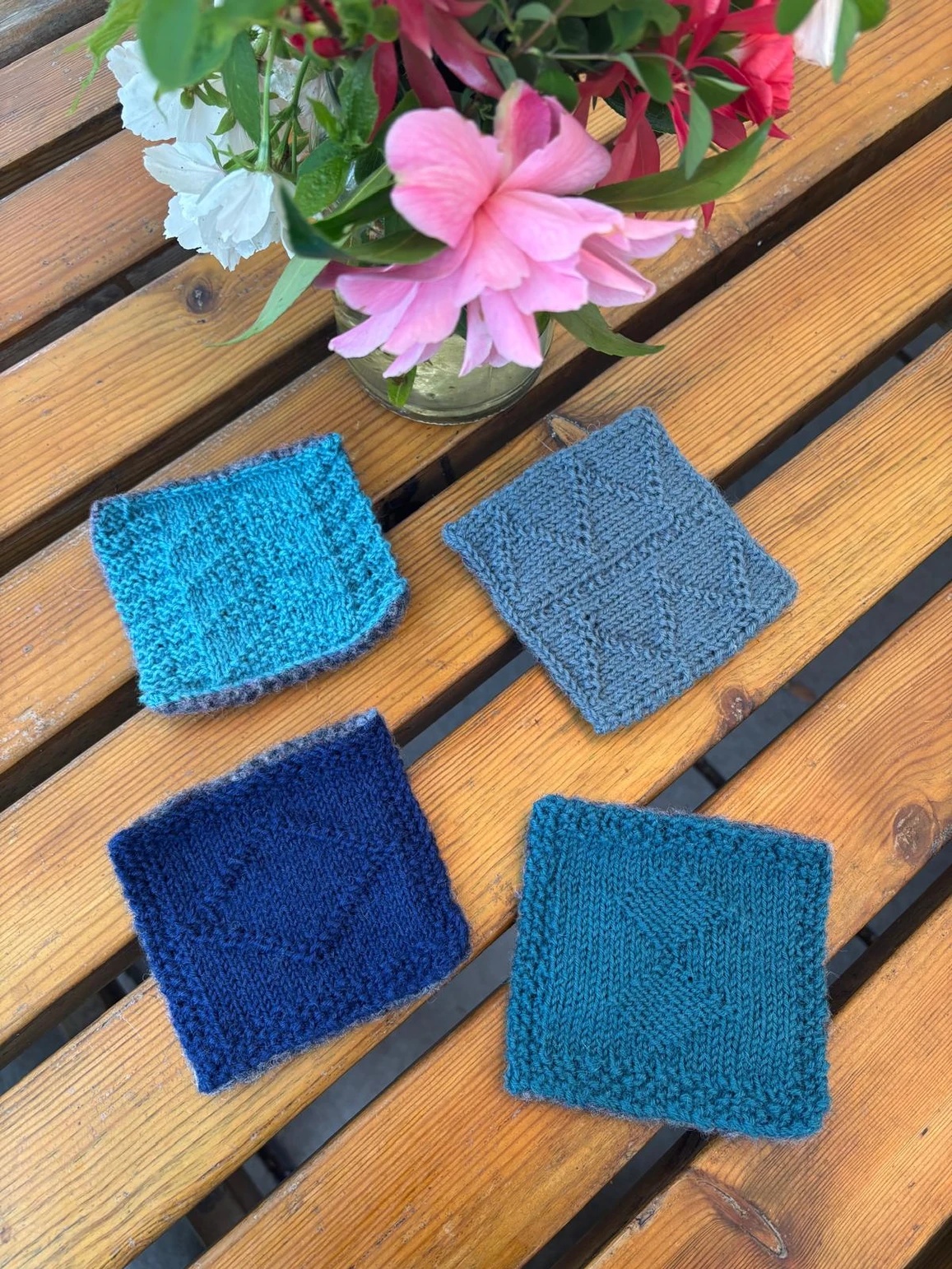
    Handmade coasters made from shetland wool by the Stich & Spin Group

    Our coasters are based on knitting patterns for traditional fisherman’s ganseys, the origins of which are still debated, though evidence suggests they could originate from the Island of Guernsey in the English Channel, or from the Old Norse garn or ‘yarn’ suggesting Scandinavian connections.

    Ganseys were knitted in un-oiled 4 ply wool on four size 14 needles to make a firm fabric that was almost wind and waterproof. They were one-piece garments with sleeves knitted from armhole to wrist, making repair easy since a ragged cuff could just be pulled out and re knit. Their design was practical in nature, for example an absence of buttons on the front made them suitable for working with herring nets, and their lack of seams contributed to their resistance to the elements. Whilst these garments were hand knitted, there were no written instructions, with designs instead being copied from existing patterns or designed by women themselves and passed down to other relations.

    Some traditions state that a drowned man could be identified by the pattern on his gansey, with patterns being regional in nature.

    In our collection, we have a number of knitted items, as well as textile production tools, natural dye samples and recipes, and other related objects. We have two knitted ganseys, both donated to Miss Hope MacDougall in 1984 by a family in Banffshire. Her typewritten label for one of them reads: “Gansey, heather colour, stripe and diamond. 1984. Given by [donor]’s married daughter who’s mother in law had knitted it. Gardenstown.”

    It was important to us that the shop product we produced as part of the ‘Wear It or Sleep In It’ element of Sophy & White related not just to items within our collections, but the industries and stories that Hope was attempting to capture within her collecting.

    Capturing the Process: A Behind-the-Scenes Documentary

    Throughout this journey, filmmaker Beth Chalmers has been documenting the creative process, capturing the learning, collaboration, and artistry that have shaped this project. Once finished, this documentary will allow us to share our journey with a wider audience, celebrating the revival of traditional textile techniques.

    Scottish Textile Traditions: Craft & Heritage at Dunollie

    The culmination of this phase will be our special pop-up exhibition, Scottish Textile Traditions: Craft & Heritage at Dunollie, taking place on Saturday, May 10th, from 4 PM to 7 PM at Dunollie Museum, Castle & Grounds. This event will be a unique opportunity to step into Scotland’s textile past, featuring a rich display of historical tools, such as looms and spinning wheels, alongside rare textiles from our collection, many of which have never been publicly exhibited before.

    Live demonstrations of traditional spinning and weaving techniques will provide hands-on insight into the craftsmanship that has been passed down through generations. Visitors will even have the chance to try their hand at spinning, gaining a deeper appreciation for the time-honored skills that shaped Scotland’s textile industry.

    A highlight of the evening will be an academic talk by expert Catherine Gilles, who will delve into the history of Dunollie’s textile traditions, bringing context to the objects on display and enriching our understanding of the role textiles played in Scotland’s past.

    This event will also mark the official launch of our new shop product, crafted by Stitch & Spin, celebrating the heritage techniques we have been exploring. Guests will enjoy exclusive after-hours access to the museum, shop, and castle, along with a specially curated menu and refreshments, including a glass of fizz, to enhance the evening’s atmosphere.

    For those with a passion for history, craft, and traditional skills, this is an event not to be missed!

    Advancing the Collections Work

    Alongside our exhibition preparations, our work with Dunollie’s textile collections has continued to grow. Volunteers have been meticulously documenting key objects, ensuring their histories are preserved for future generations. Others have been carefully selecting items for display at the exhibition, curating a selection that tells a compelling story of Scotland’s textile past.

    Looking Ahead

    With just weeks to go until the exhibition, we are focused on finalizing the remaining details and ensuring this event is a fitting celebration of everything we have learned and achieved through Wear it or Sleep in it. This has been a truly collaborative effort, and we are incredibly grateful to our volunteers, team members, and supporters who have helped bring this project to life.

    We can’t wait to welcome you to Scottish Textile Traditions: Craft & Heritage at Dunollie and share this journey with you!

    Tickets can be found at: Scottish Textile Traditions: Craft & Heritage at Dunollie | Dunollie Museum Castle and Grounds

    This was made possible thanks to the generosity of National Lottery Players through funding from the National Lottery Heritage Fund. If you have any questions or wish to get involved in Sophy & White: The Dunollie Collections Unboxed Project, please email anna@dunollie.org

  • A new box for Sophy (Timins) MacDougall’s bodice:

    A new box for Sophy (Timins) MacDougall’s bodice:

    As part of Dunollie’s ongoing collections-based project ‘Sophy & White’, one of our goals is to audit, review and stabilise both of the collections that we care for here at Dunollie. This includes a collection of historic textiles inherited from the MacDougalls of Dunollie themselves over the last decade.

    When two staff members from the National Library of Scotland visited our site in October 2024 to learn more about Dunollie, they were generous enough to offer to support our project and asked what challenges we were facing in the current stage. We were struggling to re home an iconic 19th century bodice once owned by Sophy MacDougall (formerly Timins), wife of the clan’s 25th chief. As it has such large, puffed sleeves – which to protect the garment must remain so – a custom made to measure box was necessary. The wonderful team at the National Library of Scotland kindly had this box made for and delivered to us, and one of Dunollie’s most eye-catching pieces is in a safe home once more.

    Sophy’s Bodice

    Sophy, who married Admiral John MacDougall, 25th Chief of the clan, was the great woman of the 19th century at Dunollie. After meeting Sophy in Cheltenham, John wrote to her father in 1825 that he wanted to marry her – she was just 19, and he was 36. Her father spoke highly of Sophy, writing that “I have never in one instance of her life had to complain of the disposition of a child whose whole conduct from infancy has been a source of comfort and honest pride in her parent.” He also stated that he was not able to pass over any sort of substantial dowry, should John and Sophy marry. Nevertheless, in 1826, they wed, and Sophy moved from Cheltenham, in England, up to the blustery west coast of Scotland, to take up residency at Dunollie as the wife of a Highland Chief.

    Though Sophy was to go on to become one of the most respected names in the clan’s story, it did not happen overnight. In 1835, John’s mother Louisa Maxwell wrote to his brother Allan that she had misgivings about the way that Sophy was managing Dunollie. She exclaimed that Sophy “sits upstairs like a china ornament and entrust(s) everything entirely to the management of servants, who don’t care at what risk or expense the thing is done if it is done in appearance to please the Master or the mistress.” Sophy, whether she knew about these comments or not, went on to prove herself much more than just a pretty ornament. By the time John went to sea in 1846, he was confidently leaving Sophy in charge of his affairs, rather than trusting them to his brothers, who resented his confidence in his wife. She wrote to John in 1846 that she had assured Allan “that in your absence you had confided the superintendence of your affairs to me” and that John’s other brother, Peter, had been firmly reminded that “you had thought fit to entrust me with the management of this place.” Peter was, Sophy’s letter goes on to say, in a “towering rage” – but this did not shake Sophy. She was proud that her husband seen her for the intelligent, capable woman that she was – able to run their home more effectively than any brother could in his absence.

    She proved herself a proactive and efficient estate manager later in 1846 when a disease attacks potato crops throughout the Highlands. Sophy writes to John, “some of your tenants lost 40 out of 50 barrels. Out of 45 carts dug here 5 were destroyed, and had I not made the men open the pits eight days after they were dug, and aired and dried the whole, putting some up with dry sand and some with lime, our loss would also have been serious.”

    These responsibilities that were such a source of pride for Sophy, did also weigh heavily on her, with John’s mother writing to him in 1848 to say that Sophy “is very thin and looks careworn, which is not to be wondered at after three years and more of anxiety… from the weight of responsibility that has naturally devolved upon her.” Raising 9 children whilst carrying the responsibility of an estate like Dunollie could have been no easy feat, but Sophy carried on regardless – like the strong MacDougall women before and after her.

    We have a number of items of Sophy’s clothing in our collection, from the 1830’s onward. She was fond of a bright colour palettes including various shades of pink – the boldest of which colours the bodice we have thankfully re-homed. It is a shocking shade of magenta pink, and the incredibly wide silhouette created by both the widened neckline and extravagant puffed sleeves were a particular staple of 1830’s high fashion – often paired with extravagant hats and an above the ankle length petticoat. A piece like this would have been commissioned, likely from a dressmaker in Edinburgh, as the workmanship is exquisite.

    Thank you once again to the National Library of Scotland for supporting our project and helping us give a safe and secure home to one of the treasures of our collection. Protecting our historic textiles will allow stories like Sophy’s – pretty young wife turned strong, resourceful, intelligent estate manager – to live on for generations to come. 

    Sophy’s Bodice in it’s new box

    The Sophy & White Project was made possible thanks to The National Lottery Heritage Fund for Scotland. Find out more about the project here: The Sophy & White Project | dunollie

    If you too would like to support out conservation efforts, you are welcome to email us on info@dunollie.org to find out more about our most urgent needs and ongoing projects or simply leave us a donation through our website: Donations | dunollie

  • January 2025: Sophy & White Update

    January 2025: Sophy & White Update

    Celebrating One Year! 

    The Sophy and White: The Dunollie Collections Unboxed Project has officially been underway for a full year. We are thrilled to share the progress and developments from the past few months! 

    We have been planning and implementing the next phase of the project, Wear it or Sleep in it. This exciting chapter focuses on deepening our engagement with Scottish textile heritage and fostering creativity in the community. 

    Wear it or Sleep in it 

    The first aim of Wear it or Sleep in it was to create a textile group where people could come together to learn new skills and be part of a supportive, creative community. This has been a great success, with Stitch and Spin running since October and welcoming many new faces to Dunollie. The project also seeks to strengthen our textile collections team and deepen our understanding of Dunollie’s collection of blankets, plaids, shawls, and sashes while exploring the history, origins, and production methods of Scottish textiles. This phase of the project will culminate in a pop-up exhibition showcasing the group’s newly acquired skills and insights gained from the collections and research. To document and celebrate this journey, we will also produce a behind-the-scenes documentary capturing the learning, collaboration, and creativity involved, which we can share internationally.

    Stitch and Spin 

    Our textile arts group, Stitch and Spin, has flourished into a vibrant and welcoming community! We meet every Wednesday at Dunollie from 2pm to 4pm on the Terrace, and everyone is welcome, regardless of age or skill level. Whether you want to learn a new craft, share your expertise, or simply enjoy some friendly company over tea, coffee, and a scone, we’d love to have you join us. 

    Exciting News

    We’re thrilled to share that we’ve been collaborating with videographer Beth Chalmers and have just completed the first filming sessions for our Stitch and Spin documentary! This film will show the group’s journey, highlighting their progress in learning new skills and showcasing the lovely community that has been built. 

    Collections Update 

    Our dedicated volunteers have accomplished so much over the past year. The Hope MacDougall Collection has been thoroughly reviewed, audited, and recorded. Our collections volunteers are more than confident in in handling and packing objects, as well as identifying items requiring special care and treatment. 

    For the first time, work has begun on reviewing the textile collection at Dunollie. This is an exciting milestone, and we’ve already uncovered some fascinating treasures, including this gorgeous, beaded dinner jacket and embellished bolero. 

    If you’re passionate about history, textiles, or museum work, we are always looking for collections volunteers to join our team. If you’re interested, please email Anna at anna@dunollie.org to learn more. 

    Looking Ahead 

    The coming months promise even more progress and creativity at Dunollie. Here’s what’s next: 

    • Completing the Stitch and Spin documentary filming. 
    • Planning our pop-up exhibition for the spring. 
    • Stitch & Spin will begin to work on a new retail product for the Drapers Shop. 
    • Continuing our vital work within the collections department. 

    We’re incredibly grateful for the hard work of our volunteers and the enthusiasm of everyone involved. Here’s to another year of discovery, learning, and community at Dunollie!

    This event was made possible thanks to the generosity of National Lottery Players through funding from the National Lottery Heritage Fund. If you have any questions or wish to get involved in Sophy & White: The Dunollie Collections Unboxed Project, please email anna@dunollie.org

  • Scottish Women Collectors: A Sharing Stories Event

    Scottish Women Collectors: A Sharing Stories Event

    Scottish Women Collectors: a Sharing Stories Event, was inspired by one of the two collections that we care for at Dunollie Museum, Castle and Grounds: The Social History Collection of Miss Hope MacDougall. Miss Hope – who was daughter, sister, and finally aunt to the last three successive Chiefs of the Clan MacDougall – dedicated her life to her passion, which was documenting the social history of Scotland’s Highlands and Islands. She devoted years to amassing her collection, along with a handwritten inventory, extensive archival research, and her own photography, corresponding with her interests. When Hope moved to nearby Ganavan house in 1966, when she was 53 years old, she transformed her home into a museum where she proudly displayed her collections and welcomed in guests from far and wide. Hope’s collections dominated her home, as they dominated her mind and heart, and were her life’s work.


    Our event aimed to share stories not just about Hope and her collections, but about other women like her – collectors, historians, archivists and archaeologists. Women have historically been sidelined in these sectors as they have in most others, with their collecting not taken seriously, if it was considered at all. Hope was inspired by women – friends, mentors – and in turn inspired others, and we heard about these connections from our wonderful speakers on the day, before some of the industries Hope’s collection documented – textile production and basket weaving – were brought to life by our demonstrators.

    Dr. Rhona Ramsay opened the day with her presentation, I.F. Grant and Other Women Collectors – Influence and Connections, highlighting the pioneering role of Isabel Frances Grant (1887–1983) in Scottish folk collecting. Grant, a key figure in preserving folk material culture from northern Scotland, inspired other women to contribute to this emerging field throughout the early to mid-20th century. Dr. Ramsay’s talk provided an overview of Grant’s efforts to establish a Scottish folk museum, her publications, and the influence she had on collectors like Hope MacDougall, Jean Lady Maitland, Greta Fairweather Michie, and Barbara Fairweather. The presentation also explored the post-war freedoms and new technologies that empowered these women to break new ground in collecting.


    Jenny MacLeod, an AHRC/ SGSAH-funded PhD researcher at the University of Glasgow, presented The Print Collection of Catherine Spence Howden (1875-1925): A Snapshot of the Etching Revival. Jenny’s research focuses on Scottish women etchers during the Etching Revival (1880-1940). She explored Catherine Spence Howden’s print collection, held by Glasgow Museums, which was considered a “highly valuable gift” after her death in 1925. This bequest, the largest of its time, surpassed those of notable male collectors, including William Strang. Today, it is part of Glasgow Museum’s substantial collection of Scottish prints, spanning 1750 to 1960. Jenny highlighted how Howden’s decision to collect prints, during an era when women were typically encouraged to gather more “delicate” objects, can be seen as an act of resistance. She also examined the significance of Howden’s collection in the context of the Etching Revival and the broader British print market, considering why she was drawn to etchings and what these works meant to her.

    Oliver Taylor, Assistant Curator of Modern and Contemporary Scottish History at National Museums Scotland, presented ‘Ivy Jardine, Curator-come-housekeeper’: Local Historian and Curator with Global Ambitions. Taylor highlighted the remarkable work of Ivy Jardine, a former chairperson of the Fife Family History Society, curator of two museums, private archivist for the Scottish Records Association, author, and prolific donor to museum collections. Despite her prominence in the 1980s, Jardine’s contributions, especially her efforts to celebrate Lower Largo’s history and promote the life of Alexander Selkirk (the inspiration for Robinson Crusoe), are now largely forgotten. Jardine’s home, Cardy House, was described in 1984 by The Scotsman as a late-19th century time capsule, thanks to her husband’s family’s habit of never discarding anything. Jardine recognized the importance of this historical trove, appointing herself as its curator. She also opened a museum in Selkirk’s birthplace to further celebrate his legacy. Taylor’s paper examined Jardine’s global outreach efforts to promote her collections and explored why her legacy has faded. It also assessed the significance of her collection—over 3,000 items, including an invaluable glass plate negative collection—now housed at National Museums Scotland.


    Catherine Gillies, in a change from the layout of the other speakers, presented the audience with questions around why women’s collections tend to differ from more traditional, curated museum collections. Catherine has experience in working with a wide range of museum collections, and she acknowledged that women’s collections historically focused on folk collecting and traditional, domestic ways of life, which was not “how things were done”. Was it because these women – who tended to be affluent and unmarried – had time that others did not to have such a small focus, travelling the length and breadth of Scotland on their journeys? Was it because they were already so far outside of society’s norms and rules that they could also break the rules of museum collecting, as it were? Catherine has hinted that these questions may form the basis for her next research project, so watch this space. 

    Professor Kate Hill, a historian at the University of Lincoln, presented ‘One of the ladies suggested it would be nice to have a museum’: Glencoe Folk Museum, Barbara Fairweather, and the DIY Ethos in the 1960s. Hill explored how Scottish women collectors of folk and social history blurred the lines between personal and professional curation. During the 20th century, the museum world was becoming more professionalized, with men increasingly seen as the leaders of folk and social history museums, which led to the marginalization of women like I.F. Grant, whose work was often dismissed as amateur. Despite this, the 1960s and 70s saw a surge in DIY curatorship, especially in the rise of small, independent local history museums. Glencoe Folk Museum is a prime example, run with non-professional governance and strong ties to women’s networks. Barbara Fairweather, the museum’s secretary and later curator, embodied this DIY spirit, operating outside formal curatorial structures and qualifications. Hill argued that the museum’s success was due to, not despite, its grassroots, gendered approach. Professor Hill’s research focuses on non-national museums and the history of women’s involvement in the sector, with an emphasis on folk and social history museums in the 20th century and the professionalization of museum workers, see Making Museum Professionals, 1850-the present – An AHRC research network (lincoln.ac.uk).


    Unfortunately, Professor Hill was unable to attend the event in person. However, she provided us with an outstanding pre-recorded presentation, which was well-received. In her absence, we were fortunate to be joined by Parris and Catriona, who were able to represent both the Glencoe Folk Museum and Barbara Fairweather.

    Dr. Nyree Finlay, a senior lecturer in Archaeology at the University of Glasgow, presented Collection, Care, and Archaeological Practice: The Potential of New Narratives from Excavating the Archives. Her paper highlighted the contributions of pioneering women like Marion Campbell, Dorothy Marshall, and Betty Rennie, who made significant strides in local archaeological heritage through surveys, excavations, and community service. Despite their achievements, their work has not received the widespread recognition it deserves.

    Dr. Finlay emphasized the importance of re-evaluating these women’s contributions by examining their archive and collection legacies. She used case studies from figures such as Fiona Gorman on Arran to illustrate how careful attention to archival practices—like packaging, storage, and labelling—can reveal insights into their social networks and the broader context of their work. Her research takes a feminist perspective on curation and collection care, aiming to offer alternative views on the roles of women in archaeology and to reframe assemblage studies from a less conventional standpoint.


    Dr. Ailsa Hutton, Curator of Modern and Rural History at National Museums Scotland, presented Birds, Baskets, and the SWRI: The Collecting Activity of Dr. Evelyn Baxter and Miss Leonora Rintoul. The paper explored the lives and diverse interests these two prominent ornithologists from Largo, Fife, known for their extensive studies on bird migration across Scotland. Their notable work, The Birds of Scotland (1953), is a testament to their contributions to ornithology. Beyond their ornithological achievements, Baxter and Rintoul had a keen interest in collecting, particularly baskets from across Scotland. In 1961, after their deaths, a collection of these baskets was donated to National Museums Scotland, significantly enriching the museum’s rural and craft collections. The paper examined how their basket collection, gathered during their ornithological fieldwork and influenced by Evelyn’s involvement with the Scottish Women’s Rural Institute, reflects their broader interests and collecting practices. Dr. Hutton’s research delved into how Baxter and Rintoul’s passions for ornithology, travel, and traditional Scottish crafts intersected, offering a comprehensive view of their collecting methods and objectives.

    Professor Hugh Cheape, representing Sabhal Mòr Ostaig and the University of the Highlands and Islands, presented ‘A Highland Folk Museum for Highland People’: I.F. Grant and the Founding of the Highland Folk Museum. Professor Cheape previously worked at National Museums Scotland until 2007, now leads the master’s program in material culture at SMO, which he established with the support of Dr. Dòmhnall Uilleam Stiùbhart. His paper focused on Dr. I.F. Grant (1887-1983), who established the Highland Folk Museum, Am Fasgadh, in Iona in 1935. Under her visionary leadership, the museum evolved into the Highland Folk Museum in Newtonmore, which earned the Scottish ‘Museum of the Year’ award in 2001. Dr. Grant’s ambition was inspired by her visits to folk museums in Sweden, Norway, Denmark, London, and the Netherlands. Her own scholarly work, such as Everyday Life on an Old Highland Farm (1924), provided an innovative look at Highland life and material culture, influencing her approach to museum creation, and highlights her pioneering contributions and the profound impact of her folk museum on Highland culture and history. Professor Cheape concluded his presentation recommending Singled Out, by Virginia Nicholson.

    Deborah Gray, a textile artist and tutor from Oban, gave a captivating natural dyeing demonstration. Specializing in natural dyeing and botanical printing, Deborah blends hand spinning, knitting, and stitching to create art that reflects themes of Place and Time, drawing inspiration from the landscape. Since 2021, she’s been the Lead Practitioner for The Rockfield Centre’s Eco Creative Cluster dye garden project, where she cultivates dye plants. With over 40 years of teaching experience, she offers workshops locally and internationally. Fresh from her fourth residency at the Icelandic Textile Centre, Deborah also founded Artspace Oban in 2023, providing studios for artists. She’s a regular participant in Art Map Argyll’s Open Studios.

    Jane Allen presented a basket weaving demonstration. Initially trained in Graphic Design, Jane discovered basketry in 1998 and has since focused on creating functional, traditional baskets for home and garden using willow grown on her smallholding near Achnamara. Lately, she’s been experimenting with new materials like willow bark, producing unique yet still practical pieces. Growing willow supports biodiversity, providing habitats for insects and birds. Basketry, using natural materials harvested just steps away from the workshop, is one of the most sustainable, low-impact crafts. Jane is proud to help preserve this ancient art form.

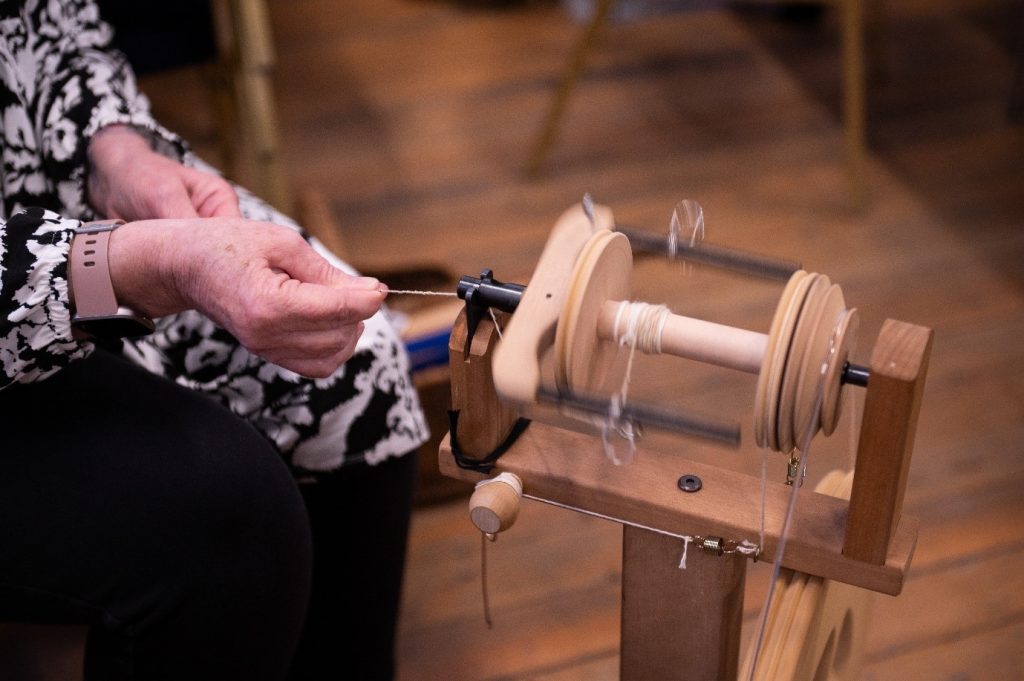
    Helen Cherry, a volunteer at Dunollie, demonstrated wool spinning using a spinning wheel from the Hope MacDougall Collection. Born in Ayrshire, Helen learned knitting from her mother’s side of the family and crocheting from her grandmother. After moving to Uist, she found a group of spinning enthusiasts who nurtured her interest, lending her a wheel to practice on. Helen quickly fell in love with the craft, finding it meditative and rewarding as she transforms raw fleece into beautifully crocheted or knitted garments.

    Thank you again to all our speakers, demonstrators, attendees, and our photographer, Lauren Fair, for making this event a success. Your contributions and participation were invaluable and the feedback we’ve received has been overwhelmingly positive. We are already excited to be planning the next steps of the Sophy & White project, which will have a focus on the vast textile collection housed here at Dunollie.

    This event was made possible thanks to the generosity of National Lottery Players through funding from the National Lottery Heritage Fund, as well as, the Oban Common Good Fund. If you have any questions or wish to get involved in Sophy & White: The Dunollie Collections Unboxed Project, please email anna@dunollie.org

  • Beyond the Stones: Medicine and WW1

    Beyond the Stones: Medicine and WW1

    As we know many people might not be able to travel to Oban this year and see our new temporary exhibition – Beyond the Stones: Magic, Medicine and the MacDougalls, members of our staff and volunteer team have agreed to share some of their research into a series of blog posts. This one was written by Shannen Provan-Sloan, our Collections Development Officer.

    Alexander James MacDougall, 29th Chief, graduated from Edinburgh University in 1894 with a Bachelor of Medicine, and later with a Master of Surgery. The eldest son of a doctor, Alexander spent the early years of his medical career in India, continuing his father Henry’s research into malaria. His work in this area was incredibly successful, eventually resulting in a species of mosquito – the aedes MacDougalli – being named after him. His medical years did not end there, however.

    In 1914 at the outbreak of World War One, Alexander joined the Royal Army Medical Corps and was posted quickly to France, a long way from his home in Dunollie, where he left his wife Colina and three daughters – Coline, Jean and baby Hope who would have been not even 1 at the time. Alexander joined the British Expeditionary Force – the six divisions the British Army initially sent to the Western Front during World War One. By 1915, Alexander had been promoted to the command of the 11th Field Ambulance, 4th Division, which fought in the Second Battle of Ypres in the same year. Field Ambulances were mobile front line medical units, which were responsible for establishing and operating a number of points along the casualty evacuation chain. It is likely that Alexander would have been in command of around 65 men in the ‘A’ section of the Field Ambulance, though a full strength Field Ambulance in all of its sections comprised 10 officers and up to 224 men, providing life saving emergency care on the front lines.

    Alexander later mobilised the 35th ambulance casualty clearing station, which he commanded in Egypt, France and Palestine. Casualty clearing stations were another part of the casualty evacuation chain, and would be located further back from the front line than Aid Posts or Field Ambulances. The job of Casualty Clearing Stations was to treat the wounded either sufficiently enough that they could return to duty or, more likely, to sustain them until they could be evacuated to a Base Hospital.

    Following almost two years with the casualty clearing station, Alexander was appointed Assistant Director of Medical Services of the 52nd Division, which came with an increase in rank to temporary Colonel.

    In June 1922, Alexander was appointed by the King to be a Companion of the Distinguished Order of Saint Michael and Saint George, which is a British order of Chivalry named in honour of two military saints. At this time, Alexander James had achieved the rank of Lieutenant-Colonel and had obviously been recognised for his contributions to front-line care for troops.


    Whilst Alexander was caring for the injured, Colina was at Dunollie, raising money for the troops and organising supplies. She published requests in the Oban Times for the provision of knitted mufflers and mittens for troops who were stationed in freezing conditions. Colina also advertised the national egg drive programme which aimed to provide eggs to soldiers recovering in Scottish hospitals and send them across to France. Due to their high nutritional value, eggs were seen as a priority for a wounded soldier’s diet during recovery. Colina put Dunollie forward as a deposit location for local eggs, advertising this both through the Oban Times and on posters throughout the town of Oban.


    Whilst pushing the egg drive, knitting clothing and advertising for mittens and mufflers, Colina was also using her own home here at Dunollie as a way to fundraise for injured troops or those on the front line. In 1917, Dunollie hosted a garden party, seeking to use the funds to improve comfort for troops. The day was a resounding success, raising £228 to be sent overseas. Colina also became the chairperson of the Oban Voluntary Committee and the Vice President of the Lorn Division of the British Red Cross Society, which ran the Dungallan Auxiliary Hospital in Oban. If you are interested in this topic, you might like one of our previous blog posts: Oban War Efforts during World War 1 (dunollie.org)

    This incredible couple provided both direct and indirect care to countless wounded troops throughout the First World War, with Alexander James going on to serve in the Home Guard as a welfare officer in WWII. Between them, they tended to the wounded, evacuated them to safe hospitals, kept them warm, fed them and sent money to their aid. Not only did Alexander commit his medical skills to caring for injured soldiers, but Colina, with three girls to raise, devoted her time to fundraising, knitting, volunteering, and advertising for ways to care for the men overseas. You can find out more about Alexander James and Colina in our temporary exhibition Beyond the Stones: Magic, Medicine and the MacDougalls!

  • Sophy & White Project: Volunteer Update

    Sophy & White Project: Volunteer Update

    The Sophy and White: The Dunollie Collections Unboxed Project is now fully underway. In January we started the recruitment process to create a team of volunteers who would contribute to the project by reviewing, auditing and recording the collections in the Dunollie storerooms. Through advertising and hosting a volunteer open day, we have managed to form a team of 15 fantastic volunteers!

    In early April, we organized a guided tour of the grounds for volunteers, this helped to provide everyone with some background history, helping to contextualize the project and collections. We organized training sessions for volunteers on object handling and packing. Delivered by Catriona, the curator at Glencoe’s Folk Museum, these sessions taught our volunteers valuable skills which are needed to work with our collections. This included handling objects, identifying different materials and labelling items. Following this, Trustee Jayne MulQueen delivered training sessions on textile handling. This gave our volunteers an in-depth understanding of working with our vast textile collection. Jayne highlighted the importance of materials sensitivity, preservation, proper storage and display techniques.

    We are now eight months into the project and our volunteers are making great progress. We are incredibly grateful as in this time, we have uncovered a huge number of items which had been accumulated by Hope MacDougall and the Clan over the years. Most of Hope’s collection is local, holding many items of great significance to Oban and Dunollie. This 1902 Oban High School Dux Medal is still in its original presentation box:

    Hope’s collection also contains objects from a range of countries and periods. In their first week volunteering, Helen and Fiona uncovered a ceramic oil lamp of Roman descent, which Hope acquired when visiting the Holy Land.

    Many of the collection’s objects were given to Hope by her friends and relatives. This carved, wooden Maori Tiki with paua shell eyes, was gifted in 1967 by Christina MacDonald from Wellington, New Zealand.

    Our volunteers stay in regular contact with one another using a group chat, sharing these exciting finds and discussing their origin, date, use and importance. They help each other better understand objects and often send in research regarding items that we are uncertain about!


    We would like to thank the incredible dedication and hard work our volunteers have put into the Sophy and White Project so far. Your efforts and enthusiasm have been truly invaluable. The time and care that everyone has invested in handling, cataloging, and preserving our collections ensures that these artifacts are protected for future generations to learn from and enjoy. Your contributions are crucial in bringing the history of these items to life and will allow us to share their stories.


    Thank you once again for your exceptional work. We could not have achieved such amazing progress without you. Your support is not only enhancing the quality of our collections but also strengthening our entire museum community. 

    We are always looking to recruit new volunteers. If you want to get involved in the Sophy and White Project, please email anna@dunollie.org

    This project was made possible by the National Heritage Lottery Fund for Scotland, thanks to National Lottery Players.

  • A Clipper Tale

    A Clipper Tale

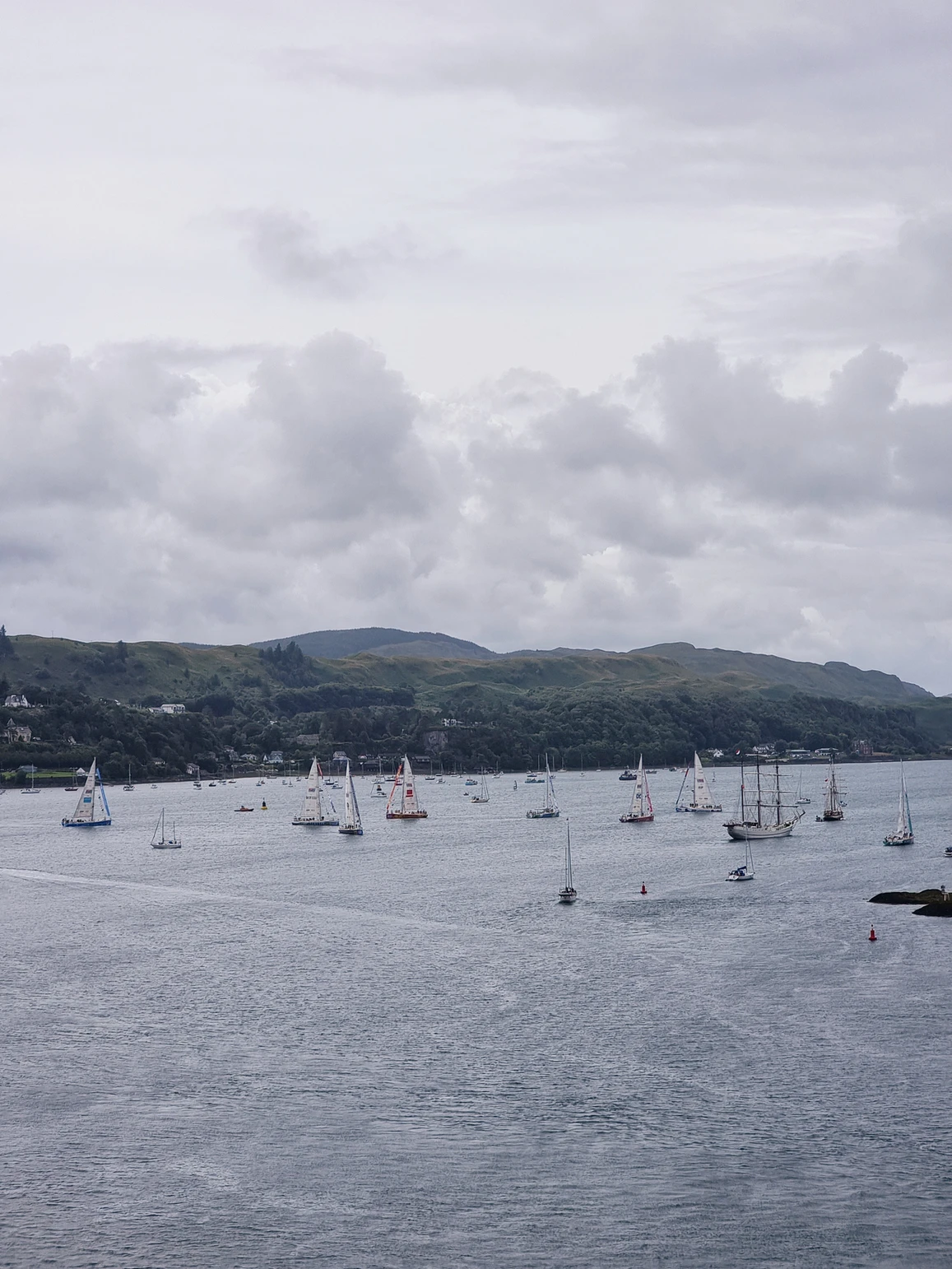
    It is a credit that “The Clipper Race” chose Oban to host the last stopover of this round the world test of skill and endurance. Dunollie Castle’s commanding position has seen many different vessels pass into the bay.

    In their truest form clippers were 19th century merchant ships, increasingly built to streamlined designs, maximising large sail areas to aid speed on long trade routes. Throughout the 1800’s design improvements were continual as other barques, brigs and schooners took on similar characteristics as these fast trade ships.  In the mid 1800’s wealthy private owners with a thirst for speed and racing were the dawn of the America’s cup.

    Ethics of the Far East Opium trade in the late 1830’s was very much in the press discussing the latest confrontations with the Chinese Qing dynasty. Tea and Opium were already the fastest growing trade commodities between India, China and Britain. European merchants had been selling opium into the coastal river basins of China, but the Chinese increasingly demanded their goods were exchanged for silver. The situation became untenable for the East India Co to operate legally when new Chinese laws seized and destroyed incoming opium cargoes. Such actions would later become recognized as the 1st Opium war.

    In the Dunollie archive a letter survives from these times. Naval Captain John MacDougall (25th Clan Chief) had been struggling with his finances during an extended period of half pay from the Navy. Building a new Dunollie house along with the expense of educating six sons and helping to launch their careers severely tested his resolve. His neighbour Donald Campbell wrote to him in December 1839 with a surefire opportunity to make a “large fortune in very few years” if John would “join me in smuggling opium to China”:

    My dear MacDougall

                I am as you say in no sort of hurry about the reference as to the damage at Airds, but it may be as well to have it settled when you have an opportunity of meeting with Fasnaclioch.

                If you want to make a large fortune in a very few years I can put you in a certain way of doing to join me in smuggling opium to China – A friend of mine Colonel Greville whom you may have met in Spain, sails next month for India in his new big yacht the Anonyma of 450 tons, 14 twenty four pounders and a long gun, with a crew of fifty men and in short the finest brig that ever was launched. When she gets to India she throws off her character as a yacht and off for China with opium and I calculate will run from a wallop the whole Chinese navy in case of need. Seriously the speculation is one which barring accidents must succeed – and I wish very much that you would join me in endeavouring to raise the wind for just such another craft and let us be off for the Celestine empire. The opium trade amounting to near six millions a year is now thrown open, because the East India Co in whose hands it has hitherto been, cannot from their position carry it on in defiance of the Chinese laws – and see what chance there is in the way I speak of with a fast powerful vessel that the Chinese can neither catch nor fight. It is said that Lord Dundonald is the man who finds the funds for Greville. If we were out there with such and the vessel we could seize upon an island on the Chinese coast and make it a sort of headquarters for ourselves in Co with Grevilles vessel. Let me hear what you think of all this –

                I go down to Brighton tomorrow where we remain till next week when we go to Dover where I have taken a house for a short time. I mean to pick up a little in the way of sailing a lugger which they perfectly understand at Dover and will sail; regularly all next month with the fisherman –

                My wife and youngsters are all well as I do hope yours are –

                                        Believe me

                                                    Most truly yours

                                                             Donald Campbell

    P.S. Keep the opium spec quiet my direction after the Ist January will be “Esplanade Dover”

    It appears Donald’s acquaintance Colonel Greville was building a 450 ton yacht, Anonyma; “the finest brig that ever was launched” for running the India to China trade.  In his letter Campbell suggests how they could outrun the Chinese Navy if they too could acquire a fast vessel. Campbell warned John to keep the details to himself but reply with his thoughts on the scheme.

    It is unfortunate we do not have John’s reply; but there is no evidence he became involved in any such schemes. A few years later Capt. MacDougall led a joint punitive operation to China with steam corvettes probing and overpowering the Canton river forts. Throughout his career John would also see a great period of change in the Royal Navy as warships adapted to steam power. He took great interest in design changes and was involved in various sea trials and as Admiralty Superintendent at Southampton he would see many different sail and steam combinations. Here at Dunollie Museum we store a lithographic sail/steam diagram of a warship and store many of John’s possessions, letters, uniforms and charts. Awarded for distinguished service he retired as a Vice Admiral still patriotically volunteering his services into old age.

    Written by: Martin Petrie, Volunteer and Trustee.

  • A Wee Update from Shannen:

    A Wee Update from Shannen:

    Well, the time has come, the end of my apprenticeship here at Dunollie! I have been part of the team for almost a year, and it truly has been the most wonderful experience.

    I have got the chance to do so many things that I have never done before: giving the guided tour; delivering primary school workshops; and of course, learning about collections care. I detailed my experience of learning the tour and working alongside my colleagues to deliver school workshops in my six-month blog, so I will skip over them for now. But I will always (always, always) find time to talk about our collections!

    Having my first job in the sector at a place as unique as Dunollie has been an immensely interesting experience. We care for two collections here – the Hope MacDougall social history collection and the Clan collection itself – and they intersect at the idea of telling stories about people. The Clan collection is mainly comprised of textiles belonging to the family from around the 19th century onwards, and contains some incredibly significant pieces including the only known five-piece Highland Revival tartan suit, and a beautiful 19th century beetle wing dress of cream silk. There are stories to be found both in these, and also the less extravagant pieces – lots of the MacDougall textiles show evidence of being mended or updated over time.

    The Clan collection also contains some incredible Jacobean textiles and weaponry – the survival of which tells a fascinating story of political rebellion. Taking, for example, the bed hangings found in the loft of Dunollie House in 2011, adorned with hand stitched Prince of Wales feathers in a beautiful indigo blue – the survival of this incredible textile suggests it was taken when Mary MacDonald, wife of Iain Ciar (22nd Chief) fled to Kerrera whilst her husband was off fighting for the Jacobite cause. Prior to her journey to Kerrera, she had stayed and held the castle at Dunollie with a handful of fighting men and the couples four children. This is one of my favourite stories to tell on our guided tour, and people are often very responsive and smile at the thought of a woman staying behind with a few good men to defend the family’s home. Mary was a staunch supporter of the cause, and to think of her packing up these beautiful bed hangings, adorned with painstakingly stitched illustrations of a proud political symbol, I think gives us such an insight into who this woman really was. Getting to know these stories of the family who have sat atop the cliff here for the last 900 years has been an incredible honour, and there is still so much more to learn.

    The other collection which we care for here is the social history collection of Miss Hope MacDougall. Hope was daughter, sister and finally aunt to the last three chiefs of the Clan MacDougall, and devoted her life to understanding the working lives of the people of Scotland’s highlands and islands, particularly those involved in fishing, agriculture and textile production.

    Hope had a deep passion for social history, and not only amassed an extensive object collection, but a large archive of research to compliment her collection and also on the history of Oban and its surrounding areas. Though her collection contains many impressive items – such as the 19th century working loom, or agricultural tools from all over the highlands and islands – I spoke recently at Dunollie’s AGM about how much I have enjoyed finding more personal details about Hope herself within her collection. Of course, her passion for social history is a huge part of who she was, but some things in her archive boxes especially speak to who she was to others. She has kept more than one letter thanking her for a lovely letter or beautiful Christmas card sent to friends across the country.

    One of the most wonderful things she left us was a handwritten inventory of her collection, complete with drawings of some of the objects in the margins. And most beautiful of all, a collection of newspaper clippings about the death of her friend and mentor, IF Grant, founder of Am Fasgadh (the Highland Folk Museum) in a folder on which she had written an echo of a newspaper heading: “Pioneer.”

    Inside, Hope had kept many stories about Grant, along with pictures which she had been sent by others who knew of her love and respect for her friend. Hope was not only a smart, passionate, woman collector. These things show us she was warm, caring, thoughtful. It feels like such an honour to try and care for the life work of someone so incredible – I am so looking forward to the plans we have in 2024 to continue with our long-term plans to maximise the impact of both of our collections.

    And that brings me to what I will be doing next! I feel so lucky to say that I have been offered a role here for the next 30 months as part of a collections-based project funded by the National Lottery Heritage Fund. So, for anyone who is used to seeing me, I won’t be going anywhere! And to anyone who maybe reads these blogs from further away, maybe there will be further updates from me about my favourite Dunollie finds in the future.

    Thanks everyone for a fantastic year!

    Shannen 😊

  • Beyond the Stones: Charmstones, Magic and Superstition

    Beyond the Stones: Charmstones, Magic and Superstition

    As we know many people might not be able to travel to Oban this year and see our new temporary exhibition – Beyond the Stones: Magic, Medicine and the MacDougalls, members of our staff and volunteer team have agreed to share some of their research into a series of blog posts. This one was written by Anna Bain, our Engagement and Learning Officer.

    Our new exhibition at Dunollie, Beyond the Stones: Magic, Medicine, and the MacDougall’s, delves into the world of charmstones and superstition, shedding light on Scotland’s rich history of belief in witchcraft and magic. Throughout the ages, certain elements and materials have been valued for their perceived ability to protect, heal, or bring good fortune.

    In the past Scotland lacked the comprehensive healthcare provisions we now take for granted. Infectious diseases therefore ran rampant, and life expectancy remained tragically short. With professional physicians scarce and access to medical texts restricted, the majority of the population relied on home remedies and charms to alleviate illness.

    Charms were a popular and affordable method for treating and warding off sickness. These talismans lacked scientific validation, however to many Scots they offered reassurance without the risk of harmful side effects. Modern medical research underscores the influence of belief in the healing process, highlighting the impact that the placebo effect could have on people.

    These amber beads, once part of a necklace, served as a charm against blindness for the MacDonalds of Glencoe in Inverness-shire. Amber, esteemed for its amuletic properties, was traditionally believed to ward off illness and cure diseases of the eyes.

    Protection wasn’t limited to humans; animals, particularly cattle, were also safeguarded through the use of charms against disease and supernatural harm. This crystal ball charmstone, enclosed by silver mounts dating back to the 16th or 17th century, belonged to the Stewarts of Ardsheal in Argyllshire. Equipped with a suspension loop for attachment to a chain, this charmstone could be dipped in water and administered to people or animals as a drink to cure or prevent illness.

    Tradition has it that the MacDougall charmstones were brought back from the Holy Land by Duncan MacDougall, the 2nd Chief, upon his return from a crusade. During their journey to confront the Campbells at the Battle of Red Ford in 1294, the MacDougalls sought guidance from a magic crystal ball. However, the crystal was spirited out of the seers’ hand mid-consultation, splitting in half, foreshadowing defeat. The MacDougalls were discouraged by this bad omen, prompting their retreat.

    Belief in the healing powers of the MacDougall charmstones persisted for generations. In 1833, Elizabeth (Kitty) MacDougall, daughter of the 25th Chief, recounted the crystals being dispatched, reportedly to combat an epidemic. In 1969, the crystals were locked up in a cupboard, in a remote part of the house, for safe keeping. The cupboard was broken into, and the crystals were stolen. The culprit, however, was never caught. Just as the Brooch of Lorn was returned to a later generation, it may be that the stolen crystals will in time be restored to Dunollie.

    The Brooch of Lorn, was said to be seized from Robert the Bruce during the Battle of Dalrigh in 1306. In the 16th century, it was reset into an elaborate turreted fixture, a form it retains to this day. Stolen by the Campbells during the siege of Gylen Castle in 1647, the Brooch remained lost for over two centuries before being recovered and returned to Dunollie. The centre stone of the Brooch, likely made of rock crystal, was prized for its perceived protective and curative qualities, serving as another talisman for the MacDougall clan against sickness and in battle, well into the 19th Century.

    The Brooch of Lorne is currently on display in the National Museum of Scotland in Edinburgh.

    Explore (nms.ac.uk)

    The Brooch of Lorne replica is currently on display in our exhibition room at Dunollie Museum Castle and Grounds.

  • Introducing Aly Robinson, the Clan MacDougall Gathering’s designated photographer

    Introducing Aly Robinson, the Clan MacDougall Gathering’s designated photographer

    With the Clan Gathering just two months away now, we thought it was about time to introduce Aly Robinson, our designated photographer for the week! We have worked with Aly several times over the last couple of years and were absolutely thrilled when she agreed to put some time aside in her very busy summer schedule to help us with the Gathering.

    Here is a small selection of her beautiful work, which illustrates her unique cinematic style with an incredible ability to convey the softest emotions with the most dramatic backdrops:

    This time, Aly has offered to do short, 30-minute photography sessions, for individuals, couples, or small groups of family and friends with Dunollie’s castle ruin and its breathtaking views as a stunning backdrop. These are only suitable for a maximum of 5 people per session, but if you are travelling with more than five loved ones and would like to do this together, it can be arranged by booking two sessions back to back (if this applies to you, please email me on florence@dunollie.org )

    Whilst these are intended for attendees of the Clan Gathering, bookings are open to anyone who is available on those dates and wishes to support our charity and the talented artist that is Aly, whilst also immortalising your visit with some stunning shots. Spaces are filling up quickly but we still have a few sessions open in the mornings and evenings of Wednesday 31st July and Thursday 1st and Friday 2nd August.

    Aly has a passion for Scotland, the Highlands and their dramatic landscape, so naturally, she has worked with our site as a backdrop before, particularly as a wedding photographer, but also, with members of our team.

    She took the following photos of my partner and me at Dunollie at the end of September last year. For context, it was a dark, cold day, I had never worked with a professional photographer before and tend to be quite uncomfortable on camera. She was such a funny, calming presence, made us both feel so at ease and we had a really lovely time during the shoot. We couldn’t wait to see how the photos turned out, but never expected them to be this special. Aly has made me feel so much prettier than I thought I could feel and I have been recommending her to everyone since.

    Find out more about Aly and her work on her website here, but remember bookings for photoshoots during the Gathering can only be booked on our website here or through the button below.

    If you have any questions, please email us on info@dunollie.org

    Best wishes,

    Florence and the Dunollie Team